
RECENT SEARCHES
Recently Viewed
The difference between a caution sign and a warning sign is the severity of the hazard, set by ANSI Z535. A Caution sign is yellow and marks a hazard that could cause minor or moderate injury. A Warning sign is orange and marks a hazard that could cause death or serious injury. A Danger sign is red and marks an imminent hazard that will cause death or serious injury. Caution is the lowest of the three alert levels.
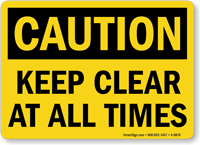
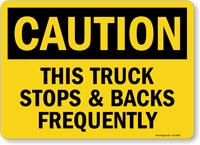
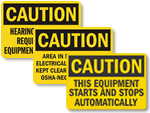
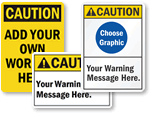
A caution sign uses a yellow header with the word CAUTION in black, next to the safety-alert symbol, which is a triangle with an exclamation point, and the hazard message below. Yellow is the OSHA and ANSI color for caution and physical hazards. This is the ANSI Z535.2 format that OSHA 1910.145 recognizes, so our OSHA caution signs read as an official safety message.
There are five OSHA safety sign categories. Danger (red) marks an imminent, life-threatening hazard. Warning (orange) marks a serious hazard. Caution (yellow) marks a minor or moderate hazard. Notice (blue) gives information or a company rule. Safety instruction (green) gives general safety guidance. Together they let a worker read the severity from the color before reading the words.
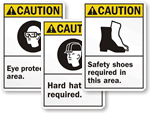
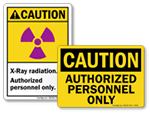
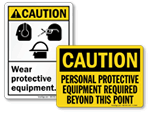
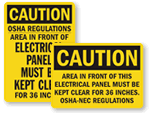
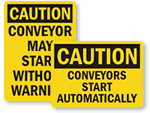
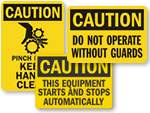
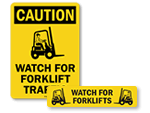
Use caution signs wherever a hazard could cause a minor or moderate injury. Common spots are around machines, forklift areas, conveyors, and electrical equipment, plus low-clearance areas, wet or slippery floors, radiation and UV areas, and places where PPE is required. For a serious or life-threatening hazard, use warning or danger signs instead.
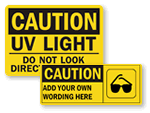
In a lab or chemical area, pair caution signs with the required chemical labeling. A caution radiation or UV safety sign marks those specific hazards, while GHS pictograms and chemical hazard signs handle the substances themselves.
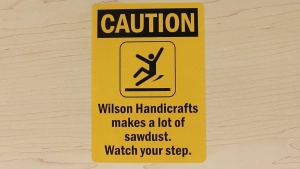
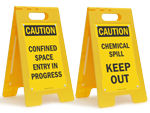
Yes. We sell caution wet floor signs and caution floor signs which mark slip hazards during mopping, spills, or wet weather. Foldable standing signs and reversible floor signs deploy and store easily in a lobby, hallway, or restroom. For a permanent slippery area, an anti-slip adhesive floor sign works underfoot.
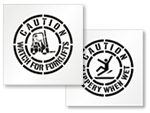
Rigid plastic is economical for indoors, and aluminum is more durable for long-term or outdoor use. For low light, choose 3M engineer-grade reflective aluminum that reflects headlights and flashlights, or an adhesive glow polyester label that glows in the dark. Reusable floor stencils and adhesive labels are cost-effective ways to mark many hazards.
Start from a custom caution template, then modify the text, symbols, and font in the customization wizard, or use the instant quoter for a specific shape, size, and color. Bilingual English and Spanish versions reach every worker. For a facility-wide set of caution signs and labels, call our team at (800) 952-1457 (Mon – Fri, 8:00am to 7:00pm EST) or email customerservice@smartsign.com for a quote.
We offer industry-leading caution signs to identify hazards that could cause minor or moderate injury, as well as Danger signs for imminent threats. Workers recognize caution signs by their yellow header with black text. Our products address common workplace risks, such as machinery, forklifts, electrical hazards, wet floors, and PPE reminders, and are available as signs, labels, floor signs, and stencils.
Call our sales team at (800) 952-1457 and get your quote in minutes!
Mon - Fri 8:00am to 7:00pm EST
Best price guarantee. Fast, free shipping.