

RECENT SEARCHES
Recently Viewed
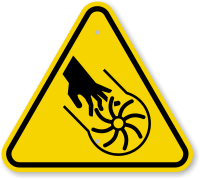
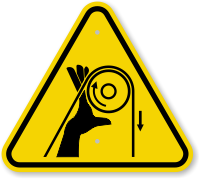
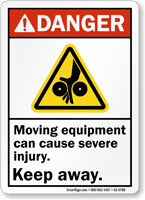
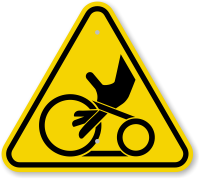
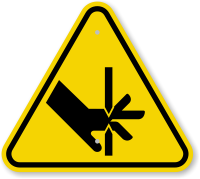
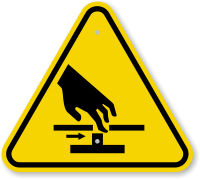
OSHA's machine-guarding standard (1910.212) requires machine hazards including points of operation and ingoing nip points to be guarded so workers can't reach them. A pinch point sign is a required warning layer, but it doesn't replace the guard or lockout: the sign warns, the guard protects, and lockout/tagout (1910.147) controls the energy during service. Use all three together.
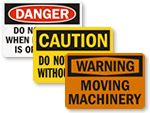
Yes. Our signs follow the ANSI Z535 system — Z535.4 for the on-product labels applied to equipment and Z535.2 for facility signs — with the correct Danger, Warning, or Caution header, the safety-alert symbol, a hazard pictograph, and a short message. That standard format is what makes a pinch point sign read the same way on any machine in any plant.
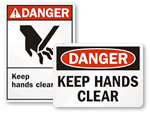
Select a header that matches the severity (Danger for severe crush hazards, Warning or Caution for lower risks), include the hand-crush pictograph for universal understanding, and keep the message brief and specific, such as "Pinch Point, Keep Hands Clear." Ensure the sign is legible from the approach distance, and consider adding the machine name or a lockout reminder for custom signs.
Place the label directly at the hazard, where workers will see it before reaching in, such as on the guard, housing, or frame next to the nip or pinch point. For larger machines, mark every access point and repeat the warning at each hazard. Avoid placing labels on surfaces that flex or are removed during normal operation to ensure the warning remains visible.
Yes. Our pinch point labels are available in adhesive vinyl and heavy-duty polyester with strong adhesives designed to bond through grease, oil, and vibration. Customers confirm they remain secure on active guards and housings. For the most challenging locations, select a rigid label or plate mounted with fasteners.
Yes. Magnetic pinch point signs attach to any ferrous machine surface and can be repositioned without leaving adhesive residue. They are ideal for equipment that is serviced, reconfigured, or only occasionally hazardous. For permanent hazards, use an adhesive label or rigid sign; for temporary or movable hazards, magnetic signs are a convenient solution.
Pinch point signs and lockout/tagout procedures provide complementary layers of hazard communication. The sign warns during normal operation, while lockout/tagout (OSHA 1910.147) isolates energy sources during servicing to prevent movement. Custom signs can reference the LOTO procedure, and do-not-operate tags help ensure safety during maintenance.
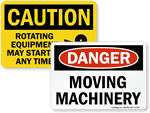
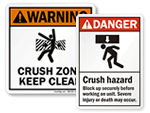
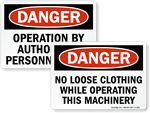
Machines often present multiple hazards. Use pinch point signs alongside crush hazard, keep hands clear, moving machinery, and general machine safety signs to address all potential risks. Consistent labeling throughout the equipment reinforces safe practices.
Yes. You can add a machine name, part number, or lockout instruction to a custom ANSI pinch hazard sign and order either a single label or bulk quantities for your facility. For plant-wide implementation with matched labels, contact our team at (800) 952-1457 (Mon – Fri, 8:00am to 7:00pm EST) or email customerservice@smartsign.com for a quote.
We produce pinch point signs and on-machine labels designed to keep hands, fingers, and feet away from moving parts that can cause injury. Each sign clearly identifies specific hazards, such as conveyor nips, gear meshes, presses, and closing gates, using a bold header, hazard pictograph, and concise "keep clear" message. Available in durable machine-mount labels or larger area signs, our products come in Danger, Warning, and Caution formats, in English or bilingual, to address every pinch and nip point in your facility.
Call our sales team at (800) 952-1457 and get your quote in minutes!
Mon - Fri 8:00am to 7:00pm EST
Best price guarantee. Fast, free shipping.